Human Design Basics: A Beginner's Guide
What Is Human Design?
Human Design is a self-knowledge system that combines four ancient and modern frameworks — Western astrology, the I Ching, the Kabbalistic Tree of Life, and the chakra system — into a single tool for understanding how you're naturally designed to make decisions, use your energy, and move through the world. Using nothing more than your birth date, time, and location, Human Design generates a personal chart called a BodyGraph: a visual map unique to you, showing your Type, your decision-making Authority, and the specific energetic mechanics that make you, you.
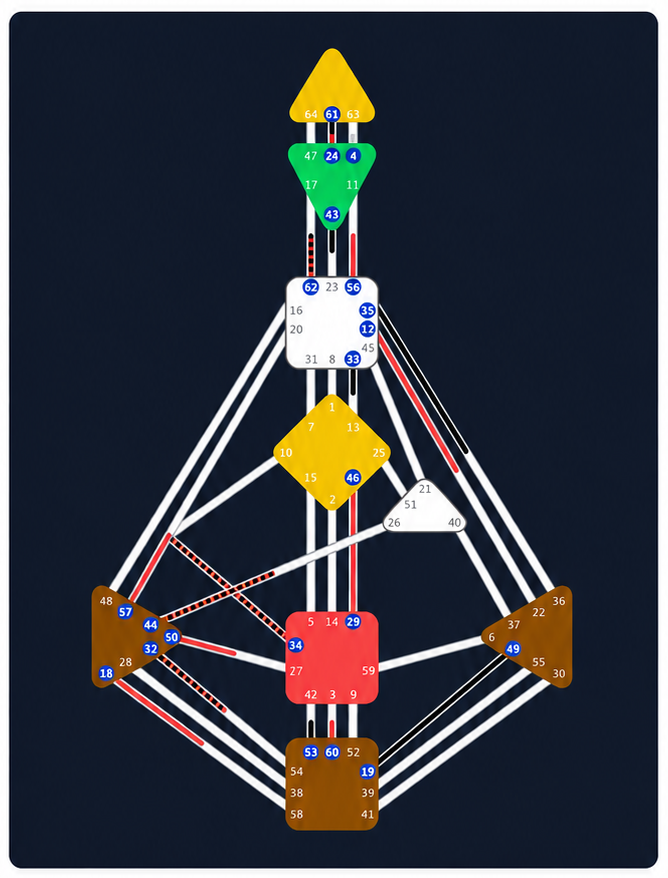
It was created in 1987 by Ra Uru Hu, who described receiving the system over an eight-day experience in Ibiza. Whatever you make of the origin story, many people are drawn to Human Design because it offers a structured framework for understanding differences in how people make decisions, relate to others, and use their energy — and permission to stop forcing themselves into strategies that don't feel natural to them.
If generic advice about productivity, decision-making, or "just pushing through" has never quite fit you, Human Design is often the thing that explains why.
The Building Blocks, At a Glance
Before you can read or understand your own chart, it helps to know the five pieces that make it up.
Type — There are five Types, and yours describes your basic energetic strategy for engaging with the world:
- Generators (about 35% of people) build, create, and respond — their sacral energy is the engine that, when used well, leads to deep satisfaction.
- Manifesting Generators (about 35%) are a hybrid: Generator energy with Manifestor speed, often multi-passionate and quick to skip steps.
- Projectors (about 20%) are natural guides who see systems and people clearly, but are designed to be recognized and invited rather than to push their own agenda.
- Manifestors (about 9%) initiate. They're built to act independently and inform others before they do.
- Reflectors (about 1%) are rare mirrors of their environment, with a decision-making process tied to the lunar cycle.
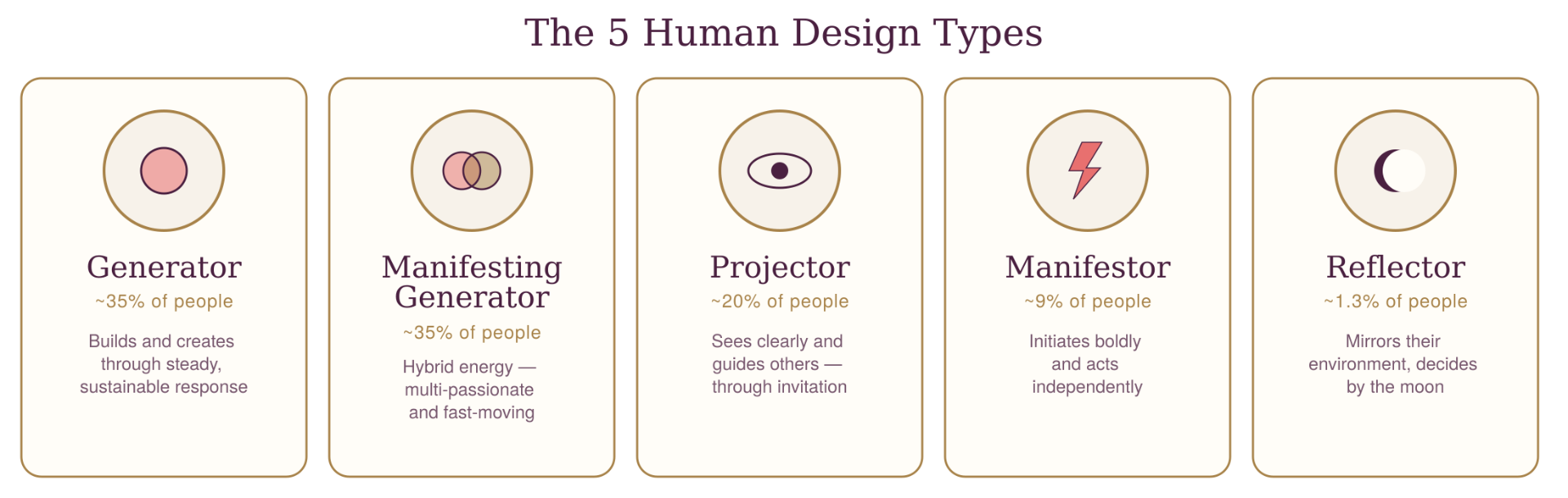
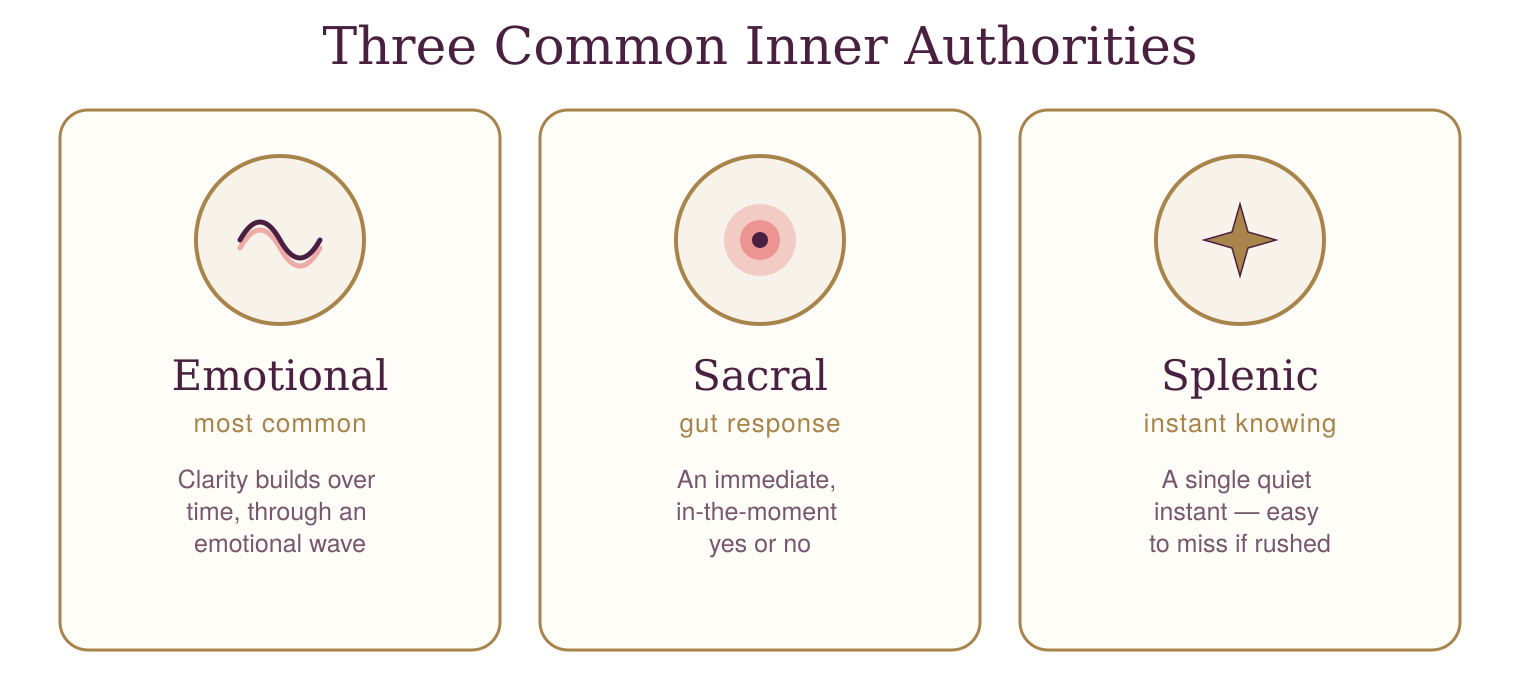
Strategy & Authority — Strategy is how each Type is designed to engage with life (a Generator responds, a Projector waits for invitation, a Manifestor informs, a Reflector waits a full lunar cycle). Authority is your personal inner compass for decisions — most commonly Emotional, Sacral, Splenic, or one of several less common variations.
Centers — Nine geometric shapes on your chart, each governing a different area of life (identity, emotions, communication, instinct, and so on). A Center is either defined (colored in, consistent energy you can rely on) or undefined (white, an area where you take in and amplify energy from the people around you).
Gates — 64 numbered points around your chart, each corresponding to one of the 64 hexagrams of the I Ching. Each Gate carries a specific theme or quality.
Profile — Two numbers (like 6/2 or 1/3) that describe your conscious and unconscious role in life — your particular flavor of how you're here to learn and contribute.
We'll go deeper on each of these below.
How to Read Your Human Design Chart
The first time you look at your BodyGraph, it can feel like staring at a subway map in a foreign city. Here's how to actually read it, step by step.
Step 1: Find Your Type. Your Type is usually listed at the top of your chart summary, and it's determined by which Centers are defined and how they connect. It's the single most load-bearing piece of information on your chart — everything else builds on it.
Step 2: Look at Your Centers. You'll see nine shapes (triangles, squares, and a diamond) arranged around the chart. Centers that are colored in are defined — consistent, dependable energy. Centers that are white/blank are undefined — open, fluid, and where you tend to absorb and amplify energy from others. Neither is "better"; undefined Centers are actually where a lot of your wisdom and adaptability comes from, once you understand them.
Step 3: Spot Your Gates. Around the edges of the Centers, you'll see small numbers — these are your Gates, ranging from 1 to 64. A Gate is "activated" if a planet was positioned there at either your birth moment (your conscious, black numbers) or roughly 88 days before birth (your unconscious, red numbers). You don't need to memorize all 64 — just know that each one represents a specific theme you carry.
Step 4: Trace Your Channels. When you have Gates activated at both ends of a line connecting two Centers, that line becomes a Channel — and it defines both Centers it touches. Channels represent a consistent, reliable trait or energy you carry your whole life.
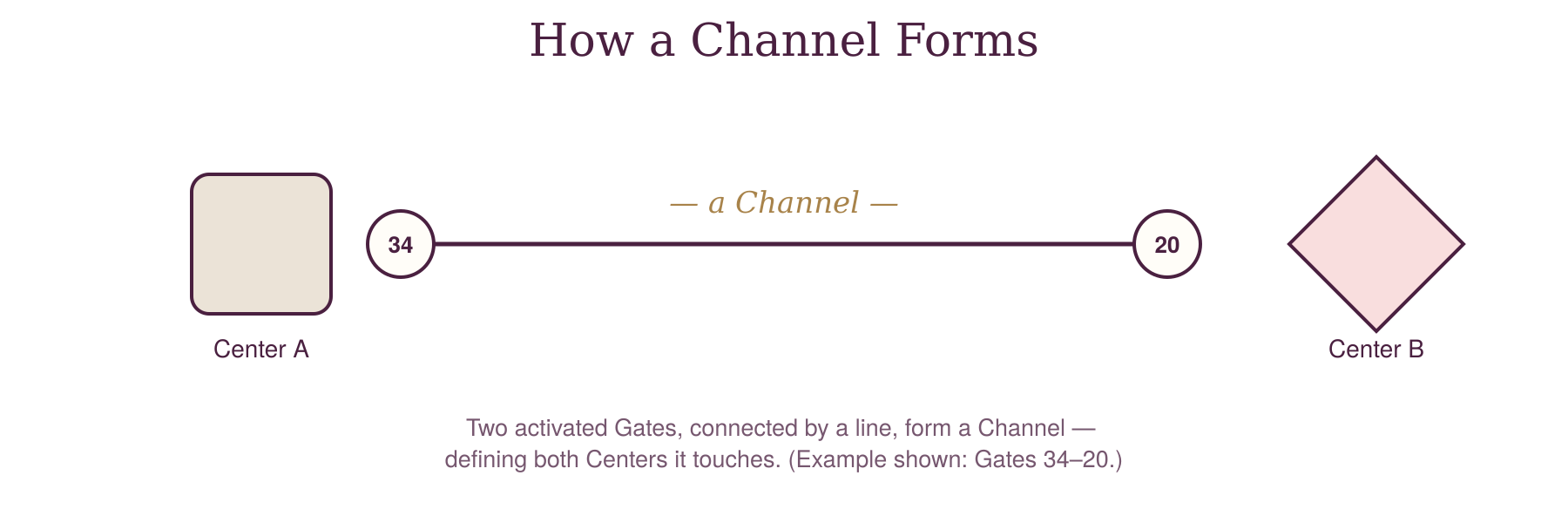
Step 5: Note Your Profile. Underneath your Type, you'll see two numbers, like 6/2. These are derived from the line numbers of your conscious and unconscious Sun and Earth placements, and they describe your Profile — your particular role or archetype (more on this below).
Once you can identify these five things, you'll have the foundation needed to start interpreting any Human Design chart — yours or someone else's. The next step is understanding what they actually mean.
How to Understand What Your Chart Means
Reading your chart tells you what's there. Understanding it tells you what to do with it. Here's where the real shift happens.
What your Type means. Your Type isn't a personality label — it's a strategy for how you're built to engage with life without burning out or forcing things. A Generator who keeps initiating instead of responding will often feel chronically frustrated, even when things technically "work." A Projector who keeps pushing instead of waiting for invitation will often feel exhausted and unseen, regardless of how good their ideas are. Most of the friction people describe as "I don't know why this feels so hard" traces back to working against, rather than with, their Type's natural strategy.
What your Authority means. If Strategy is how you engage with the world, Authority is how you decide once an opportunity is in front of you. This is one of the most practical parts of Human Design, because it's directly actionable: an Emotional Authority means your clarity arrives over time, through an emotional wave, not in the heat of the moment. A Sacral Authority means your body has an immediate, gut-level yes or no. A Splenic Authority means your knowing comes in a single quiet instant, easy to miss if you're not listening. Learning your Authority is often the fastest way Human Design becomes useful day to day — it's the antidote to decisions made from pressure, fear, or what you think you "should" do.
What your undefined Centers reveal. Undefined Centers get a bad reputation they don't deserve. They're not weaknesses — they're the places where you're naturally open to absorb, amplify, and eventually develop wisdom about whatever that Center governs. The catch is that they're also where conditioning happens: where you can unconsciously pick up other people's emotions, beliefs, or pressure and mistake them for your own. Recognizing which Centers are undefined in your chart is often the single biggest "oh, that's why" moment people have — it explains the parts of yourself that feel inconsistent or overly influenced by whoever you're around.
What your Profile means. Your Profile describes the lens through which you learn and the role you're here to play. A 1 tends to find grounding through research and going deep. A 2 often has a natural gift that others see in them before they see it in themselves. A 3 learns through trial, error, and direct experience. A 4 builds their path through their network and close relationships. A 5 carries a kind of projected, larger-than-life energy others look to for solutions. A 6 moves through distinct life phases, gradually shifting from trial-and-error toward eventually becoming a living example for others. Your Profile is the combination of two of these — your conscious role and your unconscious role — and it colors how your Type and Authority actually show up in daily life.
Putting It Together
None of these five pieces — Type, Strategy, Authority, Centers, Profile — tells the full story on its own. The point of Human Design isn't to memorize definitions; it's to start noticing where your real, lived experience lines up with what your chart describes, and to use that as permission to stop operating by rules that were never built for you.
If you want to go deeper on any one piece of this:
To explore what your design might be pointing you toward, see Human Design for Finding Your Purpose.
To start actually applying this in daily decisions, see How to Use Human Design in Everyday Life.
Want a personalized breakdown of your Human Design chart specific to where you are today? Explore whether a comprehensive Soul Compass Report is what you need.